Yes, most businesses need a website, but "website" can mean one page: what you do, where, how to contact you, and photos of your work. How much more you need depends on how customers find you. If they find you on Instagram or TikTok, it's the page your bio link opens. If they find you on Google Maps, a website is optional for your profile but it's where many searchers go next. If every customer comes by referral or through a marketplace like Booksy or Etsy, you can manage without one until you want customers you don't already know.
Checked October 2026 against BrightLocal's Local Consumer Review Survey 2026, Clutch's and BrightLocal's 2025 small-business surveys, and Google Business Profile help.
It depends on how customers find you
The real question is what a stranger does between hearing your name and contacting you.
| How they find you | What they do before contacting you | What you need |
|---|---|---|
| Google search or Maps | Read your reviews, then open your website, call or get directions | A page that answers what, where, how much and how to book |
| Instagram or TikTok | Scroll your posts, then tap the link in your bio | One page your bio links to, with the action on it |
| Referrals | Get your number from a friend, maybe look you up | A Google profile or page that comes up when they search your name |
| Marketplaces (Booksy, Fresha, Etsy) | Book or buy inside the marketplace | Nothing extra to start |
| Online only (courses, online store) | Buy on the site | The site is the business |
Most businesses sit in two rows at once. A barber is found on Maps and booked from Instagram. A plumber gets referrals and then gets looked up.
Customers still check the website
In BrightLocal's 2026 survey of 1,002 US adults, published in February, 54% said they check the business's website after reading positive reviews, up from 32% in 2019. Other next steps: 37% read more reviews, 31% visit the location, 24% check the business's social media and 20% contact the business. Overall, 66% keep researching after a good review; 34% are ready to buy or book.
How many small businesses have a website depends on who asks:
- Clutch (406 US owners, 5 August 2025): 83% have one, 17% don't. Of those without, 34% said it's "not relevant to my industry". Only 16% blamed cost.
- BrightLocal (778 US owners and managers, published August 2025) asked which platforms they use to market online. 40% named a dedicated business website, behind Facebook (50%) and Instagram (44%).
The two measure different things. Clutch counts owners who have a site. BrightLocal counts owners who market with one, a smaller group. Most small businesses have a site; fewer put it to work. Customers look either way.
Instagram instead of a website: what a profile can't do
Instagram, Facebook and TikTok are where many customers find you. They're a weak place to be found again.
Your account can disappear. In June 2025 TechCrunch reported Instagram users, business owners among them, saying they'd been banned without breaking any rules. One called the account "my livelihood, my full-time job". Meta gave no on-record statement. Two months later Western Australia's Small Business Development Corporation advised owners to "build your online presence through your own website". Every card, sign and listing that points at a lost account points at nothing.
You don't decide who sees your posts. Instagram says it uses "a variety of algorithms, classifiers, and processes", and that how each person uses the app "heavily influences the things you see and don't see" (Instagram, May 2023). A web page sits still until someone opens it.
A web page opens without an account. Any browser, any phone, nothing to install. That's the customer who got your name from a neighbour.
A page on a free address is still the vendor's address, and only a domain of your own is yours for good. What the page gives you is control: you decide what's on it, and no feed ranks it.
None of this means dropping Instagram. It's where the work gets seen. Getting clients from Instagram works best when the bio link opens a page that takes the booking or the quote.
Do you need a website for Google Business Profile?
No. The website field is optional. Google's eligibility rule is about how you serve customers: "a business must make in-person contact with customers during its stated hours" (Google).
If you fill it in, Google says "you can share your business's website with your customers on your Business Profile". Its guidelines ask for "a website that represents your individual business location", and say not to use "URLs that redirect or 'refer' users to landing pages or phone numbers other than those of the actual business, including pages created on social media sites" (Google Business Profile guidelines). Google lists social profile links separately, in select regions. Your Google Business Profile website covers what to put in the field.
The minimum that works
One page, five things, in the order a customer acts:
- Who and what, in one line: "Mobile dog grooming in east Austin."
- How to reach you: tap to call, text, WhatsApp or email.
- Where: a map, or the areas you cover.
- Proof: photos of real work.
- The next step: book, request a quote, see the menu, or order.
Put hours and prices in as plain text. A customer who lands on it can decide and act without reading your story. A one-page website shows the layout for a salon, a plumber and a food truck.
Three mistakes that cost customers
- Putting your Instagram URL in Google's website field. Google's guidelines name pages on social media sites among the URLs to avoid there.
- Hours or prices only inside an image. Nobody can copy them, and search engines read text far better than pictures.
- No action on the page. A page that only describes you sends the customer back to search.
What the minimum costs
| Route | Price (US) | First year | Own domain |
|---|---|---|---|
| Wix Free | $0, with a Wix banner ad | $0 | Needs a paid plan, from $17.77/mo billed yearly |
| Carrd Pro Standard | $19 a year | About $30 with a .com | Yes |
| InBio | Free; Pro $9/mo; Business $29/mo | $0 on Free; $90 for Pro paid yearly | No |
| Squarespace Basic | $19/mo billed yearly | $228, domain free for year one | Yes |
Sources: Wix plans and Wix free sites; Carrd Pro; Squarespace pricing; InBio pricing. Prices outside the US vary and may add VAT or GST.
A .com bought at cost from Cloudflare Registrar is about $11 a year, renewals included. Do you need a domain name covers when it's worth it. A designer is the other route; they quote per project, so ask for the first-year total including hosting.
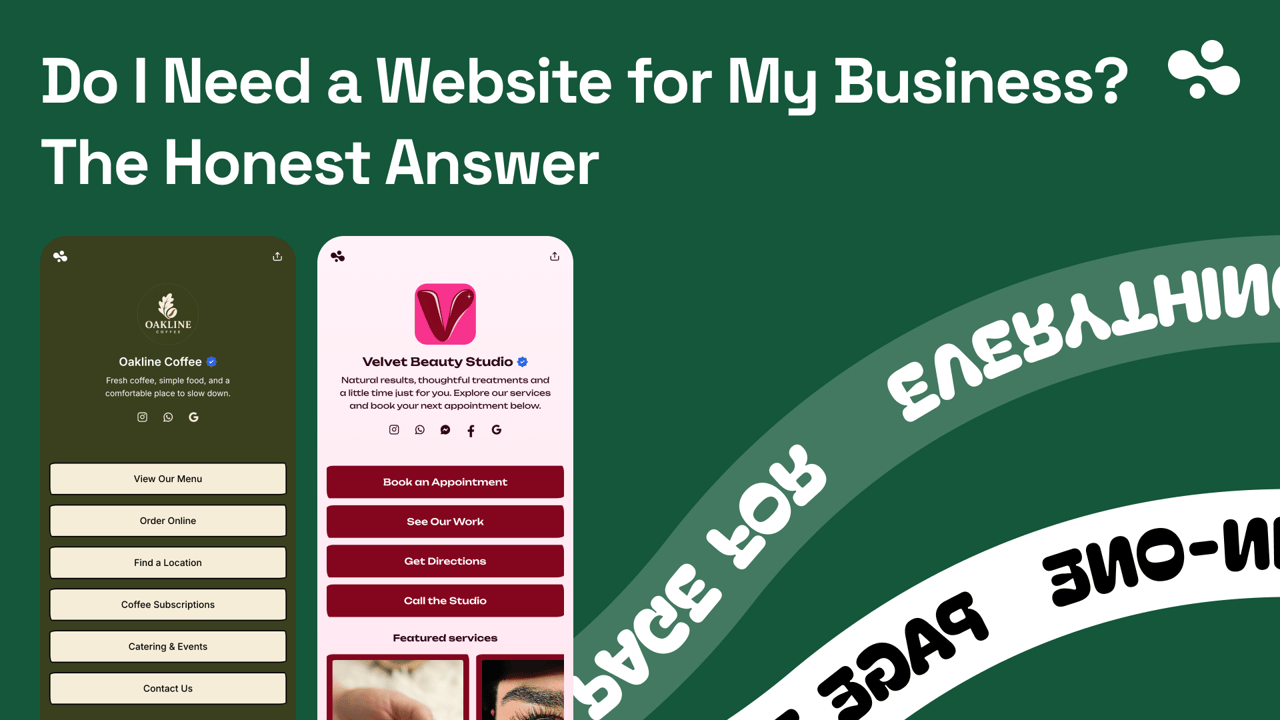
InBio is one page at in.bio/yourname, live in minutes: tap-to-call and text icons, a Google map, photo galleries and links on every plan, a quote form on Pro and booking on Business. It has no custom domain and no opening-hours block, so hours go in as text.
When you really don't need one
Skip it for now if all three are true:
- You're booked out from referrals and repeat clients.
- Every new customer already has your number, from a friend, a contractor or the side of your van.
- A marketplace brings the new ones, and the price suits you. Booksy is $29.99 a month plus $20 for each extra team member, and a one-time 30% fee on a Boost client's first visit, up to $100 (Booksy). A $60 first cut from Boost costs you $18. Fresha charges a one-time fee for new clients who find you through its marketplace, and nothing for those who come through "your own website, Instagram profile and Facebook profile" (Fresha).
When you want customers you don't already know, from people who don't use the marketplace, you need a page of your own.
Next: build the one page
Find your row in the table, then build the page that row needs. How to make a website for your business walks through each route with real costs and setup time, and every guide in this series is in A website for your business. The day it's live, put the address in your Google profile and your Instagram bio.
We make InBio. Every price here, InBio's included, was checked on the company's own pages in October 2026.